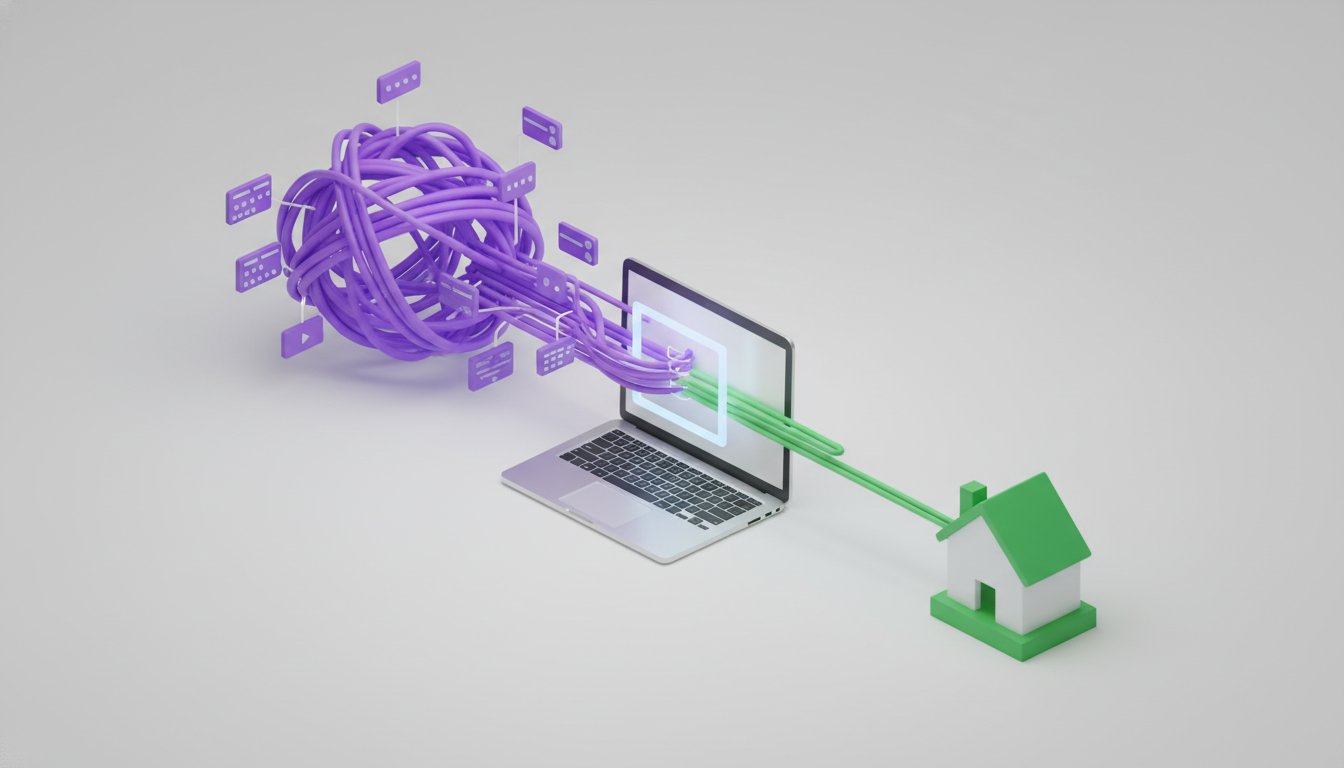

Did you know that 41% of Canadians are currently $200 or less away from failing to meet their monthly financial obligations? If high interest rates are eating your budget while you struggle to track multiple due dates, the pressure can feel overwhelming. You need a solution that simplifies your life without damaging your credit score. Finding the right path for debt consolidation canada in 2026 is no longer about a one-size-fits-all loan. It's a data-driven matching process designed to align your debt-to-income ratio with the most efficient lending mechanisms available.
We know you're looking for relief and a clear way forward. This guide promises to show you exactly how to combine high-interest debt into a single, manageable payment that fits your lifestyle. You'll learn how to leverage the current 4.45% prime rate to lower your monthly costs and protect your long-term credit health. We'll preview the 2026 lending landscape, explore updated insolvency rules, and highlight the smartest ways to find a lender that understands your specific needs.
Key Takeaways
- Execute interest rate arbitrage by swapping 19.99% credit card debt for lower-rate Canadian loan products to save on monthly interest.
- Compare the most effective 2026 strategies for debt consolidation canada, ranging from unsecured personal loans to leveraging home equity for the lowest possible rates.
- Protect your credit score during the search process by understanding the difference between hard and soft inquiries while targeting a 30% credit utilization ratio.
- Streamline your approval by gathering essential documents like T4 statements or NOAs and calculating your debt-to-income ratio before applying.
- Use AI-driven matching tools to find a lender that fits your specific financial profile instead of settling for a single bank's limited options.
What is Debt Consolidation and How Does It Work in Canada?
Debt consolidation is a sophisticated financial strategy used to streamline multiple high-interest liabilities into a single, efficient loan. Understanding what is debt consolidation helps you view it as a proactive wealth-building tool rather than a sign of distress. In the context of debt consolidation canada, this process allows you to restructure your financial foundation to stop the cycle of high-interest payments that drain your monthly budget.
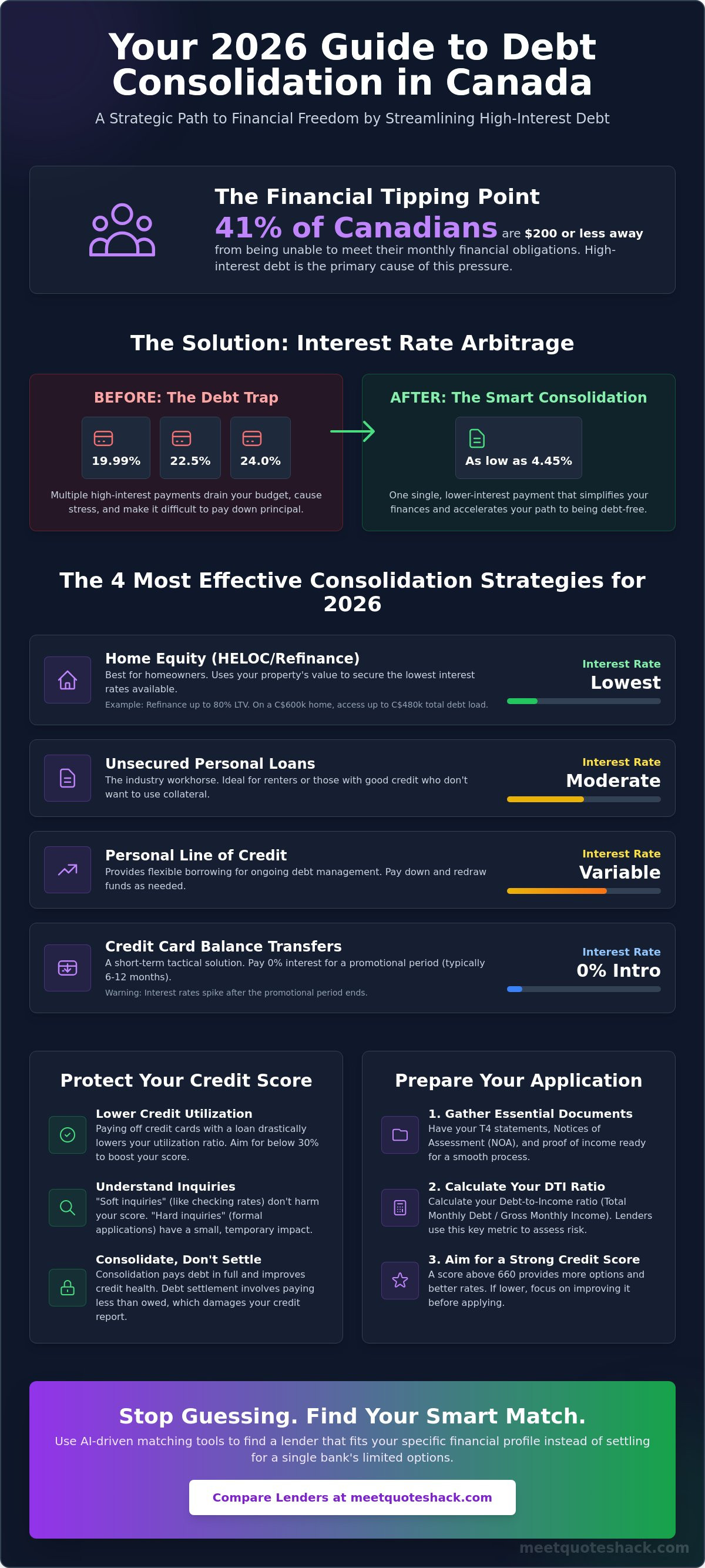
The primary goal is interest rate arbitrage. This involves replacing expensive debt, such as credit cards carrying 19.99% to 24% interest, with a lower-interest personal or home loan. By doing this, you drastically reduce the total cost of borrowing. Beyond the math, there's significant psychological relief. Managing one single due date instead of juggling five different bank portals reduces mental friction and eliminates the risk of accidental late fees. It's about removing the logistical chaos of modern banking.
It's vital to distinguish this from debt settlement. Debt settlement involves negotiating with creditors to pay back less than you owe, which inevitably leaves a scar on your credit report. Consolidation is different. You're committed to paying back the full amount, but you're doing it on terms that favor your growth. It's a professional approach to debt consolidation canada that protects your reputation with Canadian lenders while accelerating your path to zero debt.
The Core Mechanism: Interest Rate Reduction
Lenders evaluate your total debt through the lens of a weighted average interest rate. If you have multiple balances across different cards, you're likely paying a premium for that convenience. A 10% reduction in your interest rate can shave years off your repayment timeline. This happens because a larger portion of your monthly payment attacks the principal balance immediately. Interest rate arbitrage is the primary objective of consolidation, focusing on maximizing the efficiency of every dollar paid.
Debt Consolidation vs. Debt Management Plans
Choosing the right path depends on your credit health and goals. A bank-funded consolidation loan is often the superior choice for credit score recovery. It allows you to pay off revolving credit lines, which lowers your utilization ratio and boosts your score quickly. On the other hand, a Debt Management Plan (DMP) is typically managed by non-profit credit counseling agencies. DMPs are useful for high-risk borrowers who can't qualify for a new loan, but they often require you to close your accounts, which can temporarily stagnate your credit growth. If your credit score is above 660, a consolidation loan provides more autonomy and a faster path to financial freedom.
The 4 Most Effective Consolidation Strategies for 2026
Choosing the right path for debt consolidation canada depends entirely on your assets and credit profile. You aren't just looking for a loan; you're looking for an optimized repayment structure. Successful consolidation requires matching the right financial instrument to your specific debt-to-income ratio. In 2026, four primary strategies dominate the Canadian market, each offering distinct advantages for different types of borrowers.
- Unsecured Personal Loans: These are the workhorse of the industry, offering a straightforward path for renters and high-credit earners to combine balances without collateral.
- Home Equity (HELOC or Refinance): This strategy utilizes your real estate value to secure the lowest possible interest rates available in the country.
- Credit Card Balance Transfers: A tactical, short-term solution for those with smaller balances who can pay off the principal within a 6 to 12-month promotional window.
- Personal Line of Credit: Provides flexible borrowing for ongoing debt management, allowing you to pay down principal at your own pace.
Leveraging Home Equity: The Mortgage Refinance Option
Rolling high-interest debt into a mortgage at the Prime Rate, which sits at 4.45% as of May 2026, is a powerful move for homeowners. In Canada, federal regulations typically allow you to refinance up to an 80% Loan-to-Value (LTV) limit. If your home is valued at C$600,000, you can potentially access equity up to a total debt load of C$480,000. While interest rates in 2026 have remained stable, this strategy remains the most cost-effective way to secure large-scale consolidation and reduce your monthly interest drag significantly.
Unsecured Personal Loans for Rapid Consolidation
Personal loans offer rapid debt consolidation canada without the need for property ownership. Most Canadian lenders provide term lengths ranging from 3 to 5 years, creating a clear and predictable path to zero debt. Fixed monthly payments make budgeting effortless. You can check how much you pre-qualify for in seconds to see how these rates compare to your current credit card balances. This approach is highly effective for workers with a credit score of 660 or higher, as outlined in this Canadian government guide to debt consolidation. Since no collateral is required, you protect your personal assets while simplifying your financial life into one manageable payment.
How Debt Consolidation Impacts Your Credit Score
Managing the impact on your credit score is a top priority when exploring debt consolidation canada. Many borrowers worry that a new loan will trigger a permanent decline in their rating. In reality, the strategic use of consolidation often leads to a significant score increase within months. You must understand how Canadian credit bureaus interpret your actions to maximize this benefit. This starts with the distinction between a soft inquiry and a hard inquiry.
Searching for rates shouldn't hurt your score. A soft inquiry occurs when you check your own credit or use a pre-qualification tool. It has zero impact on your points. A hard inquiry happens only when you officially submit a loan application. While a hard hit might cause a temporary dip of five to ten points, the long-term gains from a healthier debt structure far outweigh this minor setback. This process is a core component of the Government of Canada's guide to debt consolidation, which emphasizes responsible borrowing habits.
Avoid the "closing accounts" trap. Once you pay off a credit card with your consolidation loan, you might feel tempted to close the account forever. Don't do it. The age of your credit history is a vital factor in your score. Keeping your oldest cards open, even with a zero balance, maintains your average account age and strengthens your profile. Simply hide the physical card to prevent impulsive spending.
The Utilization Ratio: Your Score’s Secret Weapon
Lowering your credit utilization is the fastest way to boost your score. Credit bureaus look at how much of your available limit you're currently using. Industry experts recommend keeping this under 30%. When you move C$15,000 from maxed-out credit cards into a single installment loan, your revolving utilization drops to near zero instantly. Since utilization accounts for 30% of a Canadian credit score, this shift can trigger a rapid recovery. Lenders view a structured loan much more favorably than a collection of maxed-out cards, as it demonstrates a disciplined plan for debt consolidation canada.
Maintaining Momentum After Consolidation
Protect your progress by avoiding "double-dipping." This occurs when a borrower clears their credit card balances with a loan but then starts charging new purchases to those same cards. This creates two debts instead of one. Set up automated payments for your new loan to ensure a 100% on-time payment history. You can also use QuoteShack’s pre-qualification feature to see your options without triggering unnecessary hard credit hits. This proactive approach keeps you in control while your score climbs.
Preparing Your Application: What Canadian Lenders Look For
Securing debt consolidation canada requires more than just a solid credit score. Lenders evaluate your overall financial health through a series of specific metrics and documents. You need to present a professional, data-backed snapshot of your ability to manage a new obligation. Start by checking your credit reports from Equifax and TransUnion. Errors are common, and correcting a simple reporting mistake can instantly improve your standing before you apply.
The pre-qualification phase is your most strategic move. It uses digital matching technology to identify which lenders are likely to approve your profile based on current 2026 economic conditions. This process avoids the frustration of a direct rejection and protects your credit score from unnecessary hard hits. Modern lending is about precision and speed, moving you toward a solution without the traditional friction of bank appointments.
Calculating Your Debt-to-Income Ratio
Your Debt-to-Income (DTI) ratio is the primary tool lenders use to assess risk. It measures your total monthly debt obligations against your gross monthly income. Use this formula: (Total Monthly Debt Payments / Gross Monthly Income) x 100. Most Canadian financial institutions prefer a DTI under 40% to approve a new loan. If your ratio is higher, focus on paying down small balances or documenting additional income sources to strengthen your application. A lower DTI signals financial stability and helps you secure more competitive interest rates.
Document Checklist for a Seamless Digital Application
AI-driven smart forms now verify your information in real-time, making the approval process faster than ever. To keep the momentum, have these three essentials ready for upload:
- Proof of Identity: A valid Canadian driver's license, passport, or provincial ID.
- Proof of Income: Recent pay stubs and T4 statements for employees, or a Notice of Assessment (NOA) for self-employed individuals.
- Creditor Details: A list of your current balances, account numbers, and interest rates.
Before submitting your final application, use a loan payment calculator to estimate your new monthly cost. This ensures the consolidation plan aligns with your actual cash flow. Once you're prepared, you can check how much you pre-qualify for to find a lender that matches your specific financial profile. Preparation turns a complex task into a streamlined path toward debt-free living.
Finding Your Smart Match with QuoteShack
Traditional banking is often slow and restrictive. Walking into your local branch limits you to one set of lending criteria and a single suite of products. In the current economic climate, successful debt consolidation canada requires a more agile, data-driven approach. QuoteShack acts as your intelligent facilitator, removing the friction from the search process by replacing old-fashioned bank appointments with high-tech matching. We help you find the most efficient path to a single, manageable payment without the traditional stress of manual comparisons.
Our platform uses sophisticated AI-driven matching to connect you with lenders that actually want your business. Whether you're looking for personal loans to clear credit cards or an auto loan to restructure your vehicle debt, the technology does the heavy lifting. It scans the market to identify the best interest rate arbitrage opportunities tailored to your specific profile. For homeowners, we provide direct access to professional mortgage advisors who can navigate the complexities of refinancing and HELOCs. This ensures you're always one step ahead, utilizing every available tool to protect your cash flow.
Shopping for loans usually carries the risk of multiple hard credit inquiries. QuoteShack solves this problem. Our pre-qualification tool uses soft credit pulls to show you potential rates and terms. You get to see exactly where you stand without damaging your score. This empowers you to shop with confidence, knowing your credit health remains intact while you find your perfect match. It's a modern solution for Canadians who demand speed, transparency, and results.
The Marketplace Advantage: Competitive Bidding
QuoteShack brings the lenders to you. Instead of pitching your financial story multiple times to different institutions, you enter your data once into our AI smart forms. Lenders then compete for your profile. This competitive environment naturally drives down interest rates and improves loan terms. You manage every offer through a streamlined digital dashboard that provides immediate clarity. It's a fast and transparent system designed for busy Canadians who value efficiency as much as their financial freedom.
Next Steps: Checking Your Eligibility Today
Don't let high interest rates continue to eat your monthly budget. The path to a single, manageable payment and a clear road to zero debt starts with a few clicks. Our digital process takes minutes, not days, providing you with the intelligence needed to make a bold move forward. You'll get a clear roadmap to financial stability and the reassurance that you've found the best possible deal in the 2026 market. Take control of your financial future right now. Check how much you pre-qualify for with QuoteShack and see how simple consolidation can be.
Accelerate Your Path to Financial Freedom
You now have the blueprint to master debt consolidation canada in 2026. By leveraging interest rate arbitrage and focusing on credit utilization, you can transform high-interest chaos into a single, structured payment. Remember that preparation is your greatest asset. Gathering your T4s and understanding your debt-to-income ratio puts you in the driver's seat when dealing with financial institutions. You don't have to navigate this complex landscape alone when modern technology can perform the heavy lifting for you.
Ready to see your personalized options? Check your debt consolidation pre-qualification status in minutes. Our AI-powered smart matching technology connects you with top Canadian lenders instantly. You get the clarity you need using no-impact pre-qualification tools that keep your credit score safe from unnecessary hard hits. This is the most efficient way to align your financial goals with the best available market rates. Stop managing debt and start building wealth. The tools are ready and the path is clear. It's time to take the next step toward a frictionless financial life.
Frequently Asked Questions
Is debt consolidation a good idea in Canada during 2026?
Debt consolidation is a highly effective strategy in 2026 for Canadians facing credit card interest rates between 19% and 24%. With the Bank of Canada policy rate holding steady at 2.25%, securing a loan at a lower rate allows you to reduce monthly interest drag significantly. This move is ideal if you have a stable income and a credit score above 660, as it streamlines your finances into one predictable payment.
Can I get a debt consolidation loan with a 500 credit score?
Securing a traditional bank loan with a 500 credit score is difficult because most major Canadian lenders require a minimum score of 660. You may find options through alternative or private lenders, though interest rates will be significantly higher, often reaching the 35% APR legal limit. In these cases, exploring a Debt Management Program or a consumer proposal might be a more sustainable path to long-term financial recovery.
Will debt consolidation hurt my credit score long-term?
Debt consolidation typically strengthens your credit score over the long term by drastically reducing your revolving credit utilization. While you might see a minor, temporary dip from the initial hard credit inquiry, the shift from maxed-out credit cards to a structured installment loan is viewed favorably by bureaus. Maintaining a 100% on-time payment history on your new loan will further solidify your rating within a few months.
What is the difference between debt consolidation and a consumer proposal?
A consolidation loan is a private agreement to pay back 100% of your debt at a lower interest rate. A consumer proposal is a formal legal process under the Bankruptcy and Insolvency Act where you negotiate to pay back only a portion of what you owe. Proposals have a much more severe impact on your credit rating and are reserved for those with unsecured debt up to the 2026 limit of C$325,000.
How long does it take to get approved for a consolidation loan in Canada?
Digital lending platforms often provide pre-qualification results in seconds and final approval within 24 to 48 hours. Traditional banks or credit unions may take three to five business days to process your application and verify documentation like T4s or pay stubs. Using AI-driven smart forms and digital document uploads significantly accelerates this timeline, allowing you to access funds and pay off high-interest creditors much faster.
Can I include my car loan in a debt consolidation plan?
You can include an auto loan in your debt consolidation canada strategy, but it is only beneficial if the new loan's interest rate is lower than your current car financing. Since many auto loans are secured by the vehicle, they often carry lower rates than unsecured personal loans. Always compare the APRs to ensure you aren't accidentally increasing the cost of your vehicle debt during the consolidation process.
What happens to my credit cards after I consolidate the debt?
Your credit card accounts remain active after the consolidation loan pays off the balances. You should keep these accounts open but unused to maintain your credit history length and a low utilization ratio. Closing your oldest cards can actually hurt your score. The key is to avoid the temptation of charging new purchases to the cleared cards while you are still repaying the consolidation loan.
Are there government debt consolidation programs in Canada?
The Canadian government does not provide direct loans for debt consolidation canada, but it regulates the industry through the Financial Consumer Agency of Canada. Federal rules also govern formal debt relief options like consumer proposals and bankruptcy. While the government doesn't lend you the money, it provides the legal framework and consumer protections that ensure lenders operate within the 35% APR criminal interest rate limit.